Bhutan is often imagined in the high Himalayas: prayer flags snapping across mountain passes, monasteries clinging to cliffs, pine forests disappearing into mist. But in the warm southern plains of Gelephu, near the border with Assam in India, another Bhutan is beginning to take shape.
Gelephu Mindfulness City, or GMC, is one of the country's boldest visions: a new city designed not as a concrete jungle, but as a living ecosystem of rivers, forests, temples, bridges, homes, and mindful public spaces. Spanning more than 2,600 km², it has been established as a Special Administrative Region under a Royal Charter, guided by the idea of 'Mindfulness and Prosperity.'
What makes GMC so exciting for Bhutan is that it does not reject the past to build the future. Its masterplan, designed by Bjarke Ingels Group, Arup, and Cistri, is shaped around 35 natural rivers and streams. The city's 11 walkable neighbourhoods are inspired by mandala principles, cascading like paddy fields across the landscape. Buildings are planned to remain low-rise, around three to six storeys, using timber, bamboo, stone, and traditional Bhutanese motifs such as carved cornices and rabsel windows.
For travellers, this promises a very different kind of urban experience. You might walk shaded streets where water runs nearby, cross bridges that are also temples or healing centres, and feel that the city has been designed around breathing, pausing, and noticing.
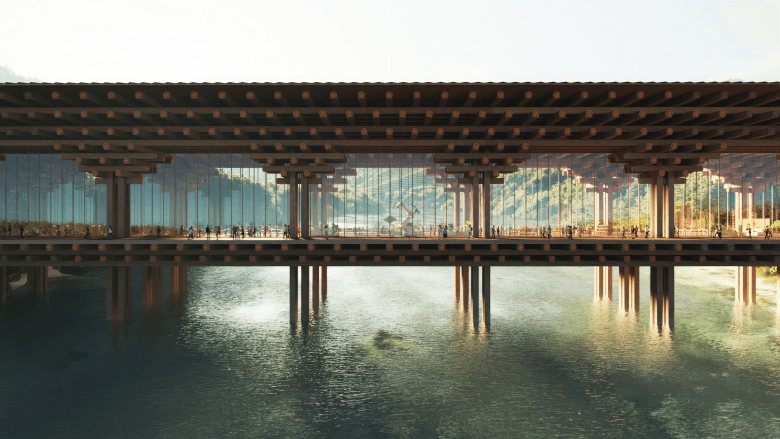
The most striking features are the 'inhabitable bridges.' The Vajrayana Spiritual Centre will allow visitors to encounter Bhutanese Buddhist practice while crossing a river. The Sunkosh Temple-Dam will combine hydroelectric power with sacred architecture, creating a dramatic 'man-made cliff' for meditative walks. The Healthcare Bridge will bring Eastern traditional medicine and Western medical science together in one symbolic space.
Even arrival is being reimagined. Gelephu International Airport, expected around 2029/2030, is planned as a mass-timber gateway carved with Bhutanese dragon motifs. Forest courtyards, natural light, yoga spaces, meditation rooms, and gong-bath areas will turn the airport itself into part of the mindful journey.
Already, GMC's spiritual heart is taking form through Project 108: the creation of 108 Jangchub Chortens along the Mau Chhu river. Each chorten will stand 15 metres tall and be spaced 108 metres apart along a 12 km corridor. Built through Zhabto, or communal voluntary work, by tens of thousands of volunteers, it is becoming a living pilgrimage of devotion and national purpose.
Gelephu matters because it expands what Bhutan can mean to the world. The country will still be loved for Taktsang, Punakha, Bumthang, and its ancient Himalayan culture. But in Gelephu, Bhutan is showing something equally powerful: that progress can be spiritual, modernity can be gentle, and a future city can still carry the soul of a kingdom.