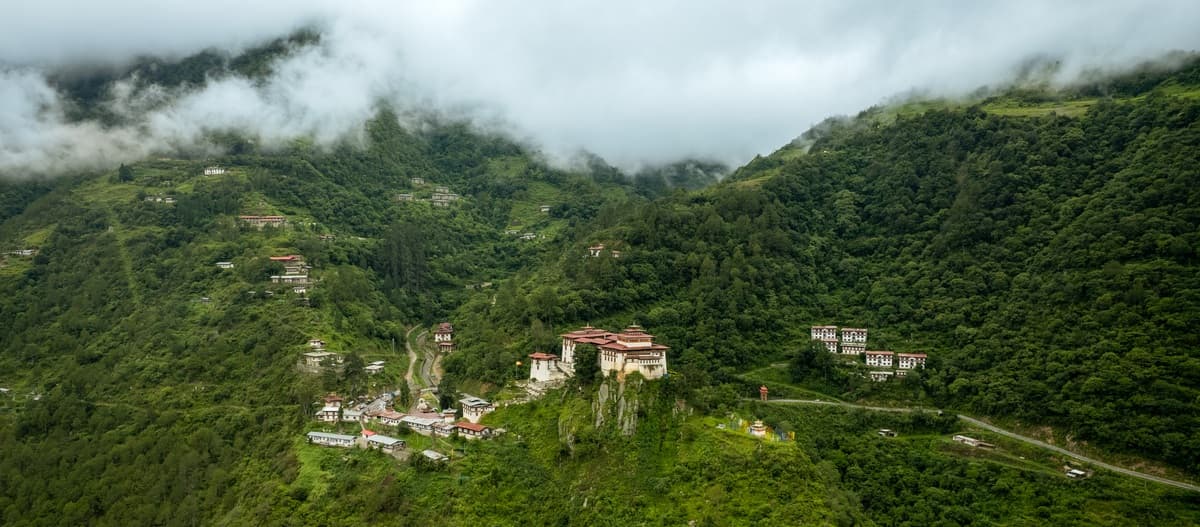
Lhuentse feels like one of Bhutan's more hidden inheritances. Set in the far east, beyond the valleys most travellers know, it is a place of steep hillsides, river bends, forested ridges and villages that seem to hold their traditions close. The journey itself creates the mood: long roads, changing light, sudden openings in the mountains, and the sense that you are moving towards a Bhutan less often seen. Lhuentse has a quiet dignity. It is associated with the ancestral roots of Bhutan's royal family, but its beauty is not ceremonial in an obvious way. It lives in its remoteness, in the sound of looms, in the curve of the Kuri Chhu, and in the feeling that time here is measured differently.
The great presence in the valley is Lhuentse Dzong, dramatically set above the river, its white walls and red bands rising from the landscape with both strength and restraint. But Lhuentse's most intimate encounters are often found away from the dzong, especially in Khoma, a village renowned for some of Bhutan's finest weaving. Here, the celebrated kishuthara is not simply a textile to admire; it is patience made visible, a language of colour, skill and inheritance passed through generations of women. A visit to Khoma is best approached slowly, with time to sit, watch the work unfold, and understand how much of Bhutan's cultural refinement is carried by hand. Further afield, sacred sites and rural settlements deepen the sense of a district shaped by devotion, craft and lineage.
Lhuentse is best visited in spring or autumn, when the long roads into the east are more comfortable and the valleys can be enjoyed without haste. Spring brings fresh growth to the hillsides and a softer quality to the light, while autumn offers clearer skies, settled weather and the richness of harvest season. Winter can be beautiful in its stillness, particularly at lower elevations, though mornings and evenings are cool and routes should be planned carefully. Summer makes the landscape intensely green, but rain can slow travel and add uncertainty to already long journeys. This is not a destination to force into an itinerary at the wrong pace; Lhuentse rewards those who give the east room to breathe.
Accommodation in Lhuentse is modest, local and practical rather than luxurious. Travellers should expect simple hotels, guesthouses and characterful stays that provide comfort without the polish found in western Bhutan's high-end lodges. That simplicity is part of the experience. The pleasure of staying here lies in being close to the texture of the place: waking to mountain air, hearing village life begin, returning from a day of weaving, temples and winding roads to a warm meal and a quiet room.
In a wider Bhutan journey, Lhuentse is for travellers who want to move beyond the classic west and understand the country through its eastern landscapes and living traditions. It works well as part of a deeper route through Bumthang, Mongar, Lhuentse and Trashigang, rather than as a quick detour. Its remoteness is not an inconvenience to be minimised; it is the very reason to go. Lhuentse turns a Bhutan itinerary into something more layered — less about famous landmarks, more about continuity, craftsmanship and the long memory of place.
Lhuentse is where Bhutan feels woven rather than displayed: thread by thread, valley by valley, quietly enduring.
More destinations