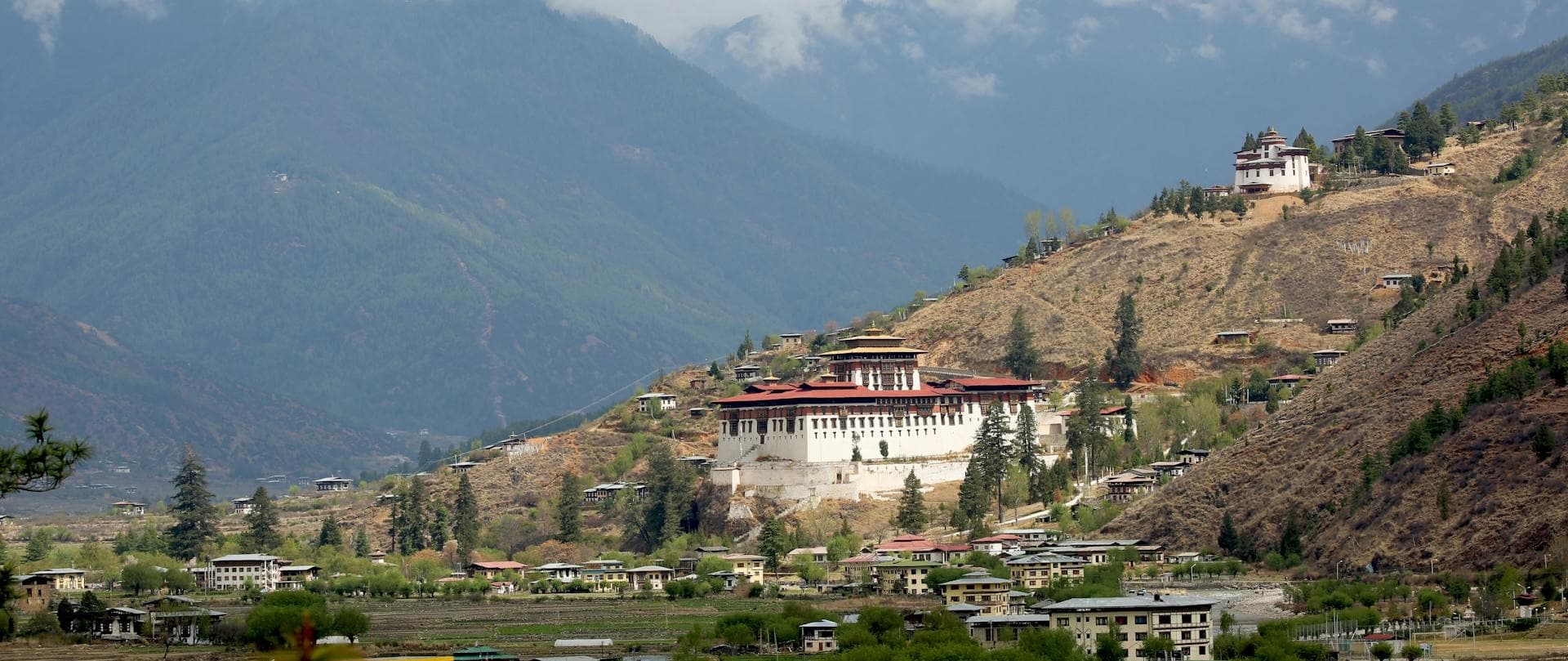
Paro is often the first breath of Bhutan. The aircraft descends between pine-covered ridges, the valley opens almost unexpectedly, and the airport appears not as a piece of infrastructure but as something hand-painted into the landscape. Whitewashed houses sit among rice fields and willow trees, their carved windows catching the mountain light. There is a softness to arrival here: prayer flags moving in the wind, the quiet geometry of farmhouses, the river tracing the valley floor. Paro feels ceremonial without trying to impress. It is both gateway and sanctuary, the place where Bhutan begins to slow the traveller down.
The great encounter in Paro is Taktsang, the Tiger's Nest Monastery, suspended against a cliff face high above the valley. The walk there is not simply a hike to a famous view; it is a gradual entering into Bhutan's spiritual imagination. Pine needles underfoot, prayer wheels turning, the monastery appearing and disappearing through trees and mist — the journey is as important as the arrival. Lower in the valley, Rinpung Dzong rises above the river with the poise of a fortress and monastery in one, while the National Museum, housed in a former watchtower, offers a quiet introduction to Bhutanese art, ritual and history. Between these landmarks, Paro's smaller pleasures matter just as much: a farmhouse meal, a cup of butter tea, a slow drive through villages where red chillies dry on rooftops and daily life continues with unselfconscious grace.
Paro changes beautifully with the seasons. Spring brings blossom, fresh green fields and crisp walking weather, with rhododendrons colouring the higher slopes. Autumn is perhaps the valley at its most luminous: clear skies, golden rice fields and mountain views sharpened by the post-monsoon air. Winter is quieter and more contemplative, with cold mornings, bright days and a sense of space around the great sites. Summer brings rain and lushness, softening the valley into shades of green. For those drawn to festivals, Paro Tshechu in spring is one of Bhutan's most celebrated religious gatherings, when masked dances, silk robes and centuries-old devotion fill the dzong courtyard.
Accommodation in Paro ranges from simple, locally run hotels to some of Bhutan's most refined luxury lodges. The best places understand the valley's quiet drama: rooms that look towards pine forests or rice terraces, fires lit in the evening, architecture that borrows from Bhutanese forms without overwhelming them. There are also characterful stays with a more intimate sense of place, where hospitality is personal and the rhythm of the day follows the valley rather than the clock. Whether you choose understated comfort or full luxury, Paro is a destination where the view, the silence and the quality of care matter more than spectacle.
In a wider Bhutan journey, Paro is usually both the beginning and the farewell. It works beautifully as a gentle introduction before travelling on to Thimphu, Punakha, Gangtey or Bumthang, but it should never be treated as a place to pass through quickly. The altitude, the pace and the emotional weight of Taktsang all deserve time. Many travellers return to Paro at the end of their journey, and by then the valley feels different: no longer the first impression of Bhutan, but the place where its meaning settles.
Come to Paro not to tick off Bhutan's most famous monastery, but to feel the country open quietly around you.
More destinations