
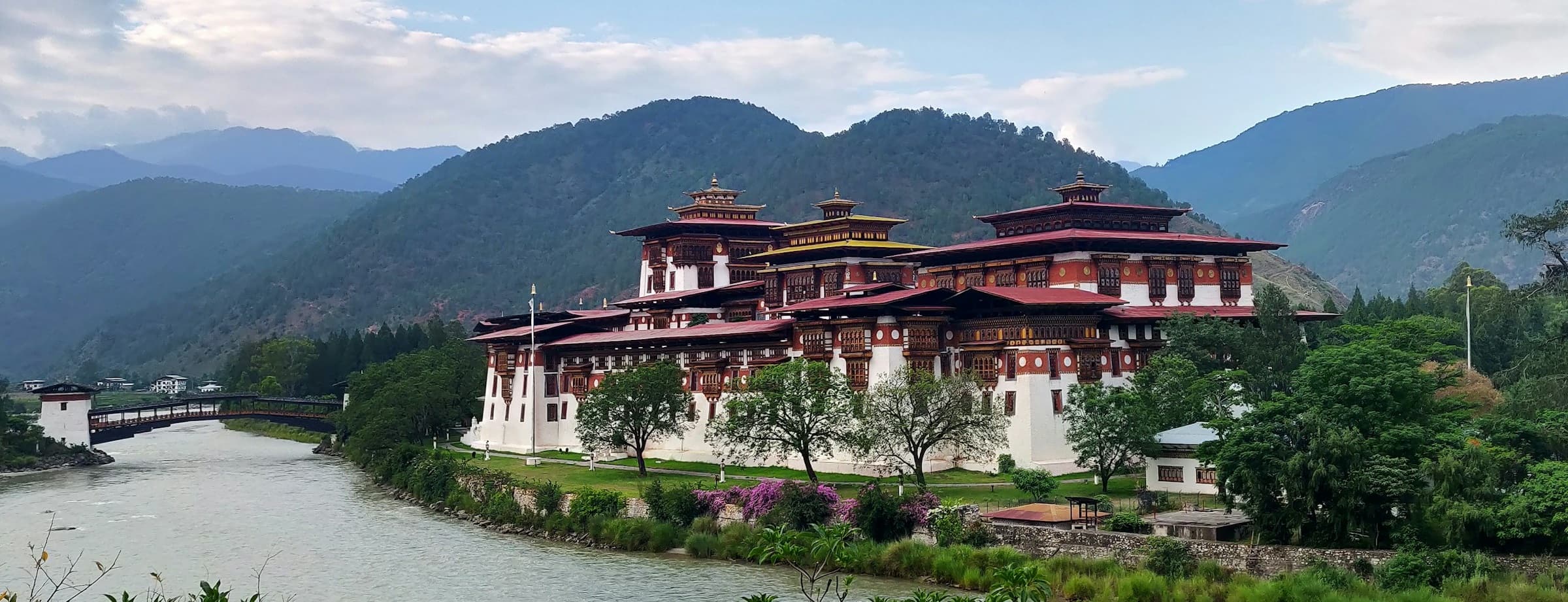
Punakha feels like Bhutan exhaling. After the high, forested descent from Dochula Pass, the road drops into a warmer valley where the air softens, the fields widen, and the landscape takes on a more generous rhythm. Jacaranda trees bloom purple in spring, rice terraces step towards the river, and traditional farmhouses sit among banana plants, cypress and prayer flags. Once Bhutan's capital, Punakha still carries a quiet authority, but it is gentler than Thimphu and more open than Paro — a valley of rivers, fertility, history and light.
The heart of Punakha is its dzong, one of the most beautiful buildings in Bhutan. It stands at the confluence of the Pho Chhu and Mo Chhu, the male and female rivers, approached by a traditional wooden bridge and framed by mountains on either side. To enter its courtyards is to feel Bhutan's sacred and political history held in one graceful place: carved balconies, whitewashed walls, deep red bands, monks crossing stone courtyards, and the sound of the river moving below. Upstream, Khamsum Yulley Namgyal Chorten offers another kind of encounter. Reached by a walk through fields and a climb above the Mo Chhu, the chorten rewards the effort with wide views over the valley and a sense of quiet remove from the world below. The short hike to Chimi Lhakhang, associated with the Divine Madman, brings a more playful and earthy glimpse of Bhutanese spirituality, while the long suspension bridge and gentle rafting on the Mo Chhu let the valley reveal itself from river level.
Punakha is one of Bhutan's most rewarding valleys for much of the year. Spring is especially lovely, with warm days, fresh fields and jacaranda blossoms around the dzong. Autumn brings clear skies and golden agricultural landscapes, making it ideal for photography, village walks and unhurried touring. Winter is also a fine time to be here, as Punakha sits at a lower altitude and is noticeably warmer than Paro or Thimphu, offering bright days and cool evenings. Summer is lush and green, though rain is more frequent and the rivers run fuller. The valley's lower elevation makes it a useful counterpoint to Bhutan's colder highlands, particularly for travellers who prefer a softer climate.
Places to stay in Punakha often make the most of the valley's sense of space. There are refined luxury lodges set above the fields, with long views across terraced hillsides and evenings that feel hushed and private. There are also comfortable boutique hotels and locally run properties that offer a closer connection to village life and the agricultural landscape. The best stays in Punakha are not necessarily about being in the centre of things; they are about waking to birdsong, looking out over fields, and feeling the valley's warmth gather slowly through the day.
In a wider Bhutan journey, Punakha is usually the graceful bridge between western Bhutan's cultural heartlands. It follows naturally after Thimphu, reached by crossing Dochula Pass, and gives the itinerary a change in mood: warmer, more rural, more expansive. For many travellers, it becomes one of the emotional highlights of the journey, not because it overwhelms, but because it settles so beautifully into memory. It also works well before continuing towards Gangtey, where the landscape rises again into open glacial valley and highland stillness.
The dzong brings you here. The valley keeps you.
More destinations