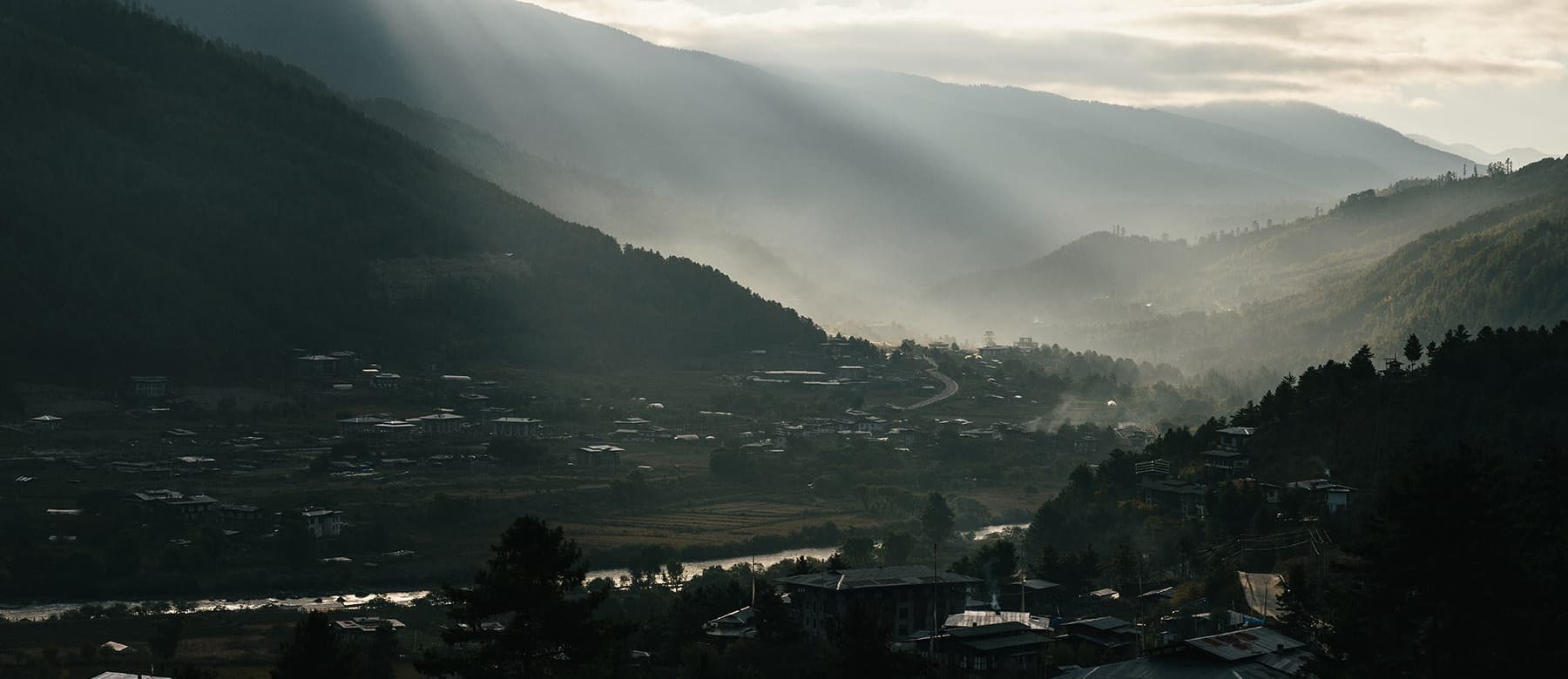
Bumthang is Bhutan's spiritual heartland, but it does not reveal itself with grandeur alone. It is quieter than Paro, more inward-looking than Thimphu, and more dispersed than Punakha — a landscape of high valleys, buckwheat fields, blue pine forests and ancient temples folded into everyday life. To arrive here is to feel Bhutan deepen. The air is cooler, the distances stretch, and the pace becomes more contemplative. Bumthang is not one single place so much as a collection of valleys — Chokhor, Tang, Ura and Chhume — each carrying its own stories, villages and sacred geography.
What makes Bumthang remarkable is the closeness of the sacred to the ordinary. In the Chokhor Valley, Jambay Lhakhang and Kurjey Lhakhang are not simply historic temples; they are places where Bhutan's spiritual memory feels alive, where butter lamps glow in dim interiors and pilgrims move with practiced devotion. Tamshing Lhakhang, with its old murals and intimate atmosphere, offers a more hushed encounter, while Jakar Dzong watches over the valley with quiet authority. Further afield, the road to Tang opens into a more rural Bumthang of farmhouses, wooded slopes and village life, with Mebar Tsho — the Burning Lake — carries one of the region's most powerful stories. It was here, according to tradition, that the treasure-revealer Pema Lingpa plunged into the water holding a burning lamp and emerged with sacred texts and a statue, the flame still alight — an act that gave the lake both its name and its enduring sanctity. Bumthang rewards travellers who are willing to give it time: to walk between temples, pause by rivers, visit a farmhouse, taste local cheese or buckwheat pancakes, and allow the valley's spiritual weight to gather slowly.
The best time to visit Bumthang is from spring through autumn, though the mood shifts beautifully across the year. Spring brings fresh growth and clear walking days, with the valleys emerging from the cold and villages returning to a softer rhythm. Summer is green and pastoral, with fields full and forests deepened by rain, though showers are part of the season. Autumn is perhaps Bumthang at its most luminous: crisp skies, harvested fields, festival season and a sense of abundance in the valleys. Winter can be very cold, especially in the mornings and evenings, but it brings stillness, sharp light and a rare sense of solitude for travellers who do not mind the chill.
Accommodation in Bumthang is more modest and characterful than in Bhutan's western luxury valleys, though comfort is very much possible. There are intimate lodges, heritage-style stays and locally run hotels that place you close to the valley's rhythm rather than apart from it. Some properties offer simple warmth, wood-burning stoves, traditional interiors and views across fields or forested slopes. Bumthang is less about polished spectacle and more about atmosphere: the smell of pine smoke, a hot meal after a day of temple visits, and the feeling of being somewhere older and quieter than the modern world.
In a wider Bhutan journey, Bumthang is usually the point at which the itinerary becomes more immersive. It is not a quick stop, and it should not be treated as one. Reaching Bumthang requires either a longer overland journey through central Bhutan or a domestic flight, but the reward is a deeper understanding of the country beyond its classic western route. It pairs beautifully with Gangtey, Trongsa and the eastern valleys for travellers who have more time, and it often becomes the part of the journey that feels most personal — less photographed, less hurried, and more deeply felt.
Bumthang is not the place you pass through for a single view; it is the place you travel to when you want Bhutan to become quieter, older and more intimate.
More destinations